
Insights
Job search advice without the fluff.
Opinionated essays on running a sharper search, plus short guides for the specific CV question you came here with.


Nothing matches “”.
Try a shorter word — “CV”, “ATS”, “tracker” — or .
Essays
Written to be read end to end · 6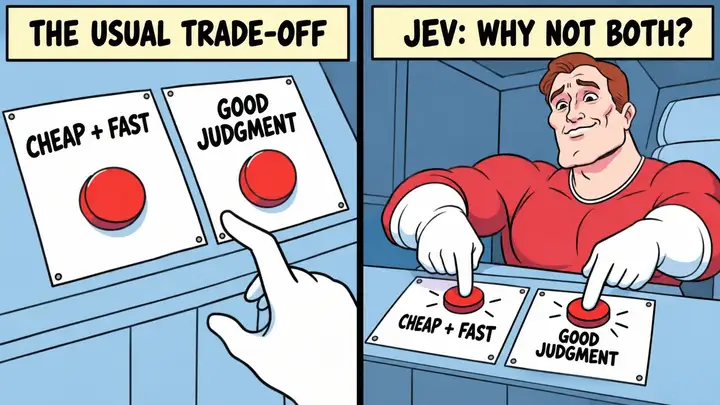
Jev vs GPT-6 Astra: near-LLM ranking quality at 1/225th of the cost
TypeSafe's Jev claims LLM-like judgment at a fraction of the price. I tested that on a task where judgment matters, ranking 241 real jobs for a candidate with GPT-6 Astra as the reference. Jev came out level with GPT-5.6 models that cost 24 to 125 times more.

The best day to apply for jobs is not the day most jobs get posted
Everyone tells you to start fresh on Monday morning. By the time you press apply, half the internet is already in the queue ahead of you.

Miss the September hiring window and your next real chance is April
Recruiters are back from the beach and your CV is still where you left it in June. A small delay now quietly costs more than anyone tells you.

Sounding senior is not the same as proving it
The words that feel most senior are the ones recruiters have learned to read past. What survives on a CV is evidence: scope, decisions, constraints, results.

What to bold on a resume: metrics, not the tech stack
Outcomes, numbers and honest scope, not tool names. Guide the recruiter's first skim without making the page noisy.

Treat your job search like a sales pipeline, not a sprint or a marathon
If your job search feels like it is going nowhere, the problem is probably not you. It is the cadence you are running it at.

Money for time: the real cost of job searching
The real cost of job searching is usually not the tool. It is the time spent drifting, the opportunity cost of delay, and the output quality you lose when a workflow cuts too many corners.

My job search experiment with OpenClaw, now turning into a full scale SaaS idea
I got 10 interviews in 4 weeks during the worst job market in years. The secret wasn't applying more, it was letting an AI tell me where I was wrong about my own chances.

Why OutRung makes you do the work (and why that's the whole point)
OutRung is not here to hand you a perfect CV from thin air. It makes you do the work because better source material leads to better judgement, stronger applications, and less wasted effort.

Less is more, even in a broken job market
Realising that most of my applications were just wishful thinking was a tough pill to swallow but it finally changed how I look for work.

One CV for 150 jobs is not a strategy, it is slow self harm
Sending the same CV to 150 jobs can feel efficient right up until the silence starts. Repeating one weak experiment at scale is still a weak experiment.
Guides & how-tos
Short answers to one specific question · 22Reading about it is the slow way.
Everything in these essays is built into the product. Free in early access.