TL;DR
- The real cost of job searching is usually the opportunity cost of delay, not the monthly line item for a tool.
- If you want quality output, you usually need a quality model, and quality model performance comes with real token costs.
- AI model tokens, token counts, and token pricing matter because they directly shape how much context a workflow can carry and how much care it can afford.
- A serious job search tool should reduce wasted time spent on weak roles, generic CV drafts, and messy tracking.
- For an active search, paying pounds per day can be rational when it shortens a long job hunt.
The real cost is not the subscription. It is the waiting.
When people search for the cost of job searching, they often start in the wrong place.
They compare one monthly fee with another. They ask whether a job search tool is worth paying for. They stare at a price tag and ignore the bigger number sitting quietly behind it.
That bigger number is time spent.
Every extra week of job searching has a cost attached to it. It is opportunity cost. It is lost income. It is the drag on your confidence when every evening disappears into admin, guesswork, and another half-tailored application you do not even trust.
I would rather pay for speed than pretend delay is free. If spending 5 to 10 pounds per day helps me move faster, that can be completely rational. The real cost is not the tool. The real cost is staying stuck for longer than necessary.
Think about the maths in real world terms. If you could land a role one month earlier, the gain is not subtle. For a product manager, someone in software engineering, or anyone applying at mid to senior level, the total cost of delay usually dwarfs the tool bill.
That is why phrases like cost of job and cost of job searching need a wider lens. The invoice matters. The opportunity cost matters more.
The hidden bill is usually AI model tokens
If you want a serious AI-assisted workflow, the expensive part is rarely the obvious overhead costs.
Hosting matters. Databases matter. Support matters. But the dominant cost in our case is usually AI model tokens.
That sounds abstract until you unpack it. A large language model prices work through token counts. Every time the model processes your profile, a job description, previous CV material, instructions, and then tries to generate text you can actually use, token usage climbs. Higher number of tokens means higher token costs.
And if you want quality output, you usually need a quality model.
That is the bit people resist, but it is true. A cheaper model can be fine for filtering or lightweight classification. A quality model is what you reach for when the work needs judgement, nuance, and language that does not collapse into generic filler. Good language models cost more because they do more.
So yes, token pricing matters. AI token decisions matter. The way a model processes context matters. If you squeeze every workflow down to the cheapest possible setting, you usually get lower quality output at exactly the point where quality matters most.
We optimise hard, but we do not optimise quality out of the product
This is not a defence of waste. Limited resources are real, and any product worth building should respect them.
We already cut costs, including the boring, deterministic work that never needed an LLM in the first place.
- We use lighter models for screening and routing tasks where full reasoning is unnecessary.
- We let application code handle filtering, ordering, and guardrails instead of paying a model to rediscover the same structure every time.
- We reduce token usage where we can, especially when the model is repeating context rather than adding value.
- We use prompt caching because repeated context should not cost full price on every run.
- We test different language models because there are genuine differences in quality model behaviour, not just differences in price.
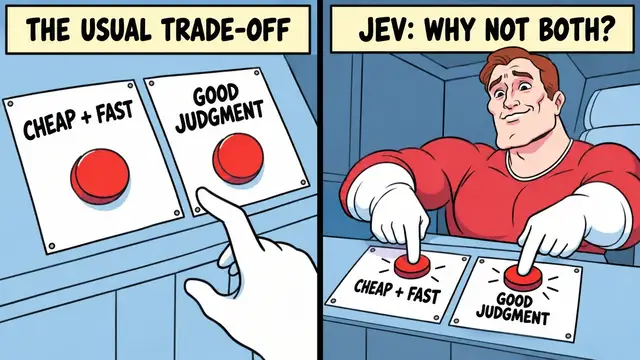
This is the trade-off. A workflow can be cheap, or it can be genuinely useful, but getting both at once is harder than people assume.
If the goal is better applications, the answer cannot just be “use fewer tokens” or “generate text faster”. The answer has to be “use tokens where they buy better judgement”.
The better comparison is total cost, not sticker price
A flat subscription can feel psychologically tidy, but it often hides the wrong comparison.
The better question is this: what is the total cost of running your search slowly?
If you are actively job searching, you are probably doing some combination of role discovery, role triage, CV tailoring, draft improvement, and application tracking. If each of those steps is weak, fragmented, or manual, the costs stack up fast.
- You spend real time chasing poor-fit roles.
- You spend more time rewriting the same CV from scratch.
- You lose context between applications.
- You forget what worked, what failed, and what the last version even said.
That is why, whenever OutRung does start charging, I want it to be usage-based rather than a flat fee. Right now the whole product is free in open beta, but the principle stands. If someone is pushing hard for a month, the workflow should support that intensity. If they slow down, costs should slow down too. That is a closer match to how job searching actually works than pretending every user has the same pattern forever.
For the right search, pounds per day is sometimes the sensible frame. Not because tools are magically valuable, but because a sharper process can shorten a long-term problem.
Where the new feature pages fit
This is also why I think the workflow matters more than a single AI button.
A good AI job search tool should cut down the field before you spend energy. A good AI CV builder should help you reuse verified evidence instead of improvising a new story every night. A good job application tracker should remember the reasoning behind the application, not just the company name and date.
Those pieces work together. Search without memory wastes time. CV drafting without judgement wastes tokens. Tracking without context creates more admin than insight.
The whole point is to spend money where it saves real time, and to save time where it compounds.
The honest caveat
None of this means every search becomes easy if you spend more.
Sometimes the market is slow. Sometimes your direction is unclear. Sometimes a role is a weak fit and no amount of token usage will rescue it. The answer is not blind optimism or unlimited spend.
The answer is to be more selective about where effort goes.
That means using better inputs, better judgement, and better tools when they genuinely help. It also means accepting that the cheapest workflow is often expensive in disguise.
Key takeaways
The real cost of job searching is usually time, not software.
Opportunity cost is what turns a slow search into an expensive one.
Token costs are not a weird technical footnote. They are part of the economics of getting better output from language models.
And if a quality job search tool helps you move faster with stronger applications, paying pounds per day can be a lot cheaper than paying with another month of drift.
Related questions
The real cost of job searching is usually the opportunity cost of delay, the time spent on weak applications, and the mental drag of a slow process, not just the subscription fee for a tool.

About the author
Tian
Tian is an AI professional, builder, and the founder of OutRung. Holding a PhD in deeptech, Tian navigated the frustrating modern job market first-hand before transitioning into the AI space. OutRung was built to share the exact strategies that made that transition successful. Tian's goal is to help everyday job seekers use AI to find their ideal roles efficiently, without needing to be computer experts themselves.